

PRE-MED Program 
PROGRAM OVERVIEW
PRE-MED is a two-semester (690 academic hours) Program offered by Adam Mickiewicz University, Poznań to candidates who want to improve their knowledge and skills in natural sciences before they start their medical studies. This comprehensive preparatory course taught in English provides a solid foundation in essential areas, ensuring you are well-prepared for the regular degree programs of medical studies.
Apart from courses in biology, chemistry, physics and mathematics, the program provides an opportunity to get basic skills in Polish and communication skills in health care.
The course lasts from mid-October 2026 to the end of June 2027 and is divided into two semesters.
PROGRAM DETAILS (Curricula)
Course dates: October 12th, 2026 – June 26th, 2027
All classes are held in English and cover lectures/seminars, practical classes and laboratories.
AMU PRE-MED includes 690 academic hours*:
- Biology - 150 academic hours
- Chemistry - 200 academic hours
- Physics - 260 academic hours
- Polish - 40 hours
- Communication in Health Care - 40 hours
*academic hour = 45 minutes
* The University reserves the right to withdraw the educational offer unless there are at least 20 candidates submitted, who have passed recruitment successfully
* meals, accommodation and insurance are not provided
APPLICATION CRITERIA
There is no entrance examination. The only requirement is to graduate at least High School and be eligible for university studies in your home country. (No failed results in the transcripts). Even though a certain level of English language is required (B1/B2).
Candidates will be selected by the Admission Committee on the basis of their scores from High School Diploma in biology, physics and chemistry or the relevant subjects and level of English language skills (confirmed by a certificate).
Deadline for the submission of your application:14.08.2026 (notification of acceptance will be given within 2 weeks after the deadline)
Step by step - admission process:
- Register and fill in on-line application form in electronic candidate database (available at: ……………………………………
- Upload the required documents into the electronic database during application process:
- - a copy of High School Diploma or its equivalent in candidate’s native language certified by candidate’s school or by public notary,
- - an English translation of the above original document , translated and certified by candidates school or by a sworn translator (does not apply to documents in English or Polish),
- - a photocopy of the applicant’s passport,
- - certificate confirming English language skills (does not apply to English native speakers),
- - proof of payment of the registration fee in order to receive the pre-acceptance letter
APPLY HERE
COURSE FEES & BANK DETAILS 
Price: 25 300 PLN tuition fee + 2000 PLN non-refundable registration fee
(ca. 7075 USD tuition fee + 560 USD non-refundable registration fee
ca. 6000 EUR tuition fee + 475 EUR non-refundable registration fee)
The registration fee has to be paid before the end of the registration period (proof of payment is required to finalize the registration procedure).
The entire amount of tuition fee (in one instalment) has to be paid after receiving the positive information about the admission.
If you will not be able to start the course because of visa rejection, your tuition fee will be fully refunded.
The tuition fee includes:
- - 690 academic hours of classes,
- - full set of study materials,
- - access to AMU library,
- - participation in Orientation Day (first week of the course),
- - Welcome pack
Above fees should be effected to the account of Adam Mickiewicz University, Poznań in PLN as per following instruction:
University name and address: Uniwersytet im. Adama Mickiewicza w Poznaniu;
ul. Wieniawskiego 1; 61-712 Poznań
title of payment: S0000444 PRE MED; name and surname
account number: 77 1090 1362 0000 0000 3601 7903
IBAN: IBAN: PL77109013620000000036017903
SWIFT: WBKPPLPP
bank name: Santander Bank Polska
Please take under consideration that you might be charged with additional costs while making the payment. The full amount of fee must appear on the University account, so please make sure that all additional banking charges are covered by you.
ADDITIONAL INFORMATION
The classes will be held on-line (from October until beginning of January) and on-site (from January until end of June).
The AMU PRE-MED Program is taught in the Northern Campus Morasko, a modern facility conveniently connected to the city center (15 minutes via a direct tram) and located in a walking distance from the dorm (5-10 minutes depending on the faculty).
Registered students might apply for accommodation in the students' dorms owned and operated by Adam Mickiewicz University, Poznań.
The cost is about:
Single room with bathroom and kitchenette - 980 PLN per month
Double room with bathroom and kitchenette - 730 PLN per person per month
If you want to read more about the dorms, click here.
CONTACT DETAILS
In any case please contact us premed@amu.edu.pl
Ms Karolina Choczaj, MA
International Exchange Advisor
Adam Mickiewicz University, Poznan
Poland
1 Wieniawskiego Street; 61-712 Poznan
Ms Dominika Dąbrowska, MSc
International Exchange Advisor
Adam Mickiewicz University, Poznan
Poland
1 Wieniawskiego Street; 61-712 Poznan
A DOZEN REASONS TO STUDY AT AMU?
- Competitive price

- Supreme academic expertise
- Central location: halfway between Berlin and Warsaw; most European capitals are accessible within 2 hours by plane!
- Poznan is one of the safest cities in Europe
- Multicultural environment
- Student-friendly city: every fourth citizen of Poznan is a student! 30,000 of them study at AMU!
- Vibrant business centre offering career opportunities for students, Poznan region enjoys the lowest unemployment rate in Poland
- Comprehensive academic offer: read on! AMU has been ranked among top-3 Universities in Poland for the last 5 years!
- A large number of professional full-time academic staff
- Advanced research opportunities: AMU got the HR Excellence in Research certificate from the European Commission and is a part of “The Excellence Initiative - Research University Program’’
- Handicap-friendly program: AMU has the largest population of students with disabilities in Poland!
- Easy access to culture
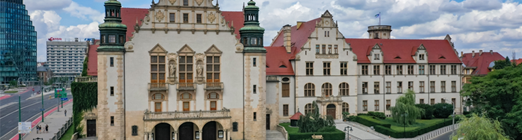
About Adam Mickiewicz University
Founded in 1919
nearly 3000 academic staff
nearly 30 000 students
1040 PhD students,
hundreds of postgraduate diploma students
1 200 international students
In the following turbulent years of Polish history, science and higher education were always vibrant in Poznań. The key role in their development was played by the Poznań Society of Friends of Sciences which preserved the academic legacy forward in partitioned Poland (1795-1918) until the official re-establishment of the University of Poznan, following the end of the First World War, in 1919.
Ever since the University of Poznań has flourished, and only one more time was it forced to go underground and provide its services in the conspiracy during the Second World War under the name of clandestine University of the Western Lands (1940-1944). Despite the Nazi German occupation it managed to educate and produce over 2,000 graduates with the help of some 300 academic teachers, who risked their lives by offering university courses in Polish, which was made illegal during the war.
If you want to learn more about AMU history, click here.
About Poznań
Founded: 9th Century
Town Charter: 1253
Area: 261.3 sq. km
Population: around 540 000 residents, over 100 000 students
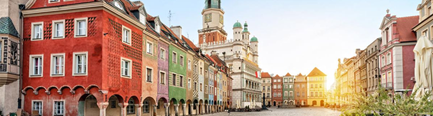
Poznan has many sports and leisure centers offering plenty of opportunities to spend your free time. During your time off, choose among Poznan’s many restaurants, cafes, pubs and clubs. A particularly charming atmosphere awaits you in the Old Market Square Area. It’s the center of nightlife in Poznan. Poznan is a city of music, theatre, visual arts and design. If you want to look for more information about the city, click here.
Full sylabus
- Biology - 150 hours of courses
Module total hours: 150 (lectures 84 h, classes 66h)
Cell Biology – course topics:
- structure and functions of the eukaryotic and prokaryotic cells
- cellular communication
- cell cycle and cell divisions
- cell engineering and stem cell research
- Methods for cell structure examination
- Teaching methods and hours: lecture (14 h), classes (10 h),
Biochemistry and molecular biology – course topics:
- structure and functions of biological macromolecules
- enzymes and metabolic reactions
- cellular respiration and fermentation
- replication, transcription, and translation
- regulation of gene expression
Teaching methods and hours: lecture (16 h), classes (10 h)
Genetics and genetic engineering – course topics:
- chromosomal and molecular basis of inheritance
- Inheritance of human disorders
- genomes and their evolution
- DNA technology and its practical application
Teaching methods and hours: lecture (14 h), classes (10 h),
Human biology – course topics:
- tissues, organs, and body membranes
- nervous system
- sensory and motor mechanisms
- skeletal system and muscle-based locomotion
- circulatory system and gas exchange
- immune system
- hormones andthe endocrine system
- nutrition and digestive system
- osmoregulation and excretion
- human reproduction and development
- human evolution
Teaching methods and hours: lecture (24 h), classes (26 h),
Microorganisms – course topics:
- bacteria and archea
- viruses
- protists
- fungi
Teaching methods and hours: lecture (16 h), classes (10).
Reading list:
Campbell Biology (Campbell Biology Series) 11th or 12th Edition, 2020 by Lisa Urry, Michael Cain, Steven Wasserman, Peter Minorsky, Rebeca Orr
- Chemistry - 200 hours of courses
General Chemistry – course topics:
- atoms
- classification and balancing of chemical reactions
- physical quantities
- fundamental chemical laws
- solutions
- acid and basis
- buffers
- chemical calculations
Teaching methods and hours: lecture (10 h), classes (30 h), laboratory (10 h)
Physical Chemistry – course topics:
- nuclear chemistry
- radioactivity
Teaching methods and hours: lecture (5 h), classes (5 h)
Inorganic Chemistry – course topics:
- the periodic table
- ionic compounds
- molecular compounds
- mole and mass relationships
- reaction rates and chemical equilibria
- chemical calculation
Teaching methods and hours: lecture (10 h), classes (30 h), laboratory (10 h)
Organic and Bioorganic Chemistry – course topics
- alkanes
- cycloalkanes
- alkenes and alkyne
- aromatic compounds
- alcohols
- phenols
- some compounds with oxygen, sulfur, or a halogen
- amines
- aldehydes
- ketones
- carboxylic acids and their derivatives
- amino acids and proteins
- enzymes and vitamins
- carbohydrates
- lipids
- nucleic acids and protein synthesis
Teaching methods and hours: lecture (20 h), classes (60 h), laboratory (10 h)
Recommended reading: Karen C. Timberlake „Chemistry – an Introduction to General, Organic and Biological Chemistry”, 11th edition, International Edition, Pearson
the Watson–Crick model
- Physics - 260 hours of courses
Module total hours: 260 (lectures 105 h, classes 115 h, laboratories 40 h)
Mechanics:
- motion, velocity, acceleration
- forces, work, Newton’s laws of motion
- energy, momentum, angular momentum, conservation laws
- gravity
- liquids – Archimedes principle, Pascal principle, Bernoulli equation, surface tension
Teaching methods and hours: lecture (25 h), classes (25 h), laboratory (10 h)
Electricity and magnetism:
- electric charge, Coulomb’s law
- electric field, electric potential, capacitors, capacity
- electric current, voltage and current, resistance, Ohm’s law
- magnetic field, Ampere’s law
- electromagnetic induction, Maxwell equations
Teaching methods and hours: lecture (20 h), classes (30 h)
Vibrations and Sound:
- harmonic motion, amplitude, period, frequency
- damped vibrations, forced vibrations, resonance
- waves – perpendicular and longitudinal, wavelength
- reflection and interference of waves
- sound – characteristics, beats, Dopler’s effect, shock wave, ultrasound
Teaching methods and hours: lecture (20 h), classes (20 h), laboratory (15 h)
Light and Optics:
- light and electromagnetic waves
- geometric optics, law of reflection, law of refraction (Snells’s law),
- refractive index
- lens equation, optical instruments
- wave nature of light - Huyghens principle, diffraction and interference of light
- polarization of light, liquid crystal display
Teaching methods and hours: lecture (20 h), classes (20 h), laboratory (15 h)
Heat and atomic structure of matter:
- atomic structure of matter
- temperature and thermal equilibrium
- ideal gas and its transformation
- heat, specific heat, calorimetry
- entropy, laws of thermodynamics
Teaching methods and hours: lecture (20 h), classes (20 h)
Reading list:
Physics – Principles with Applications, D.C. Giancoli, PEARSON Education International