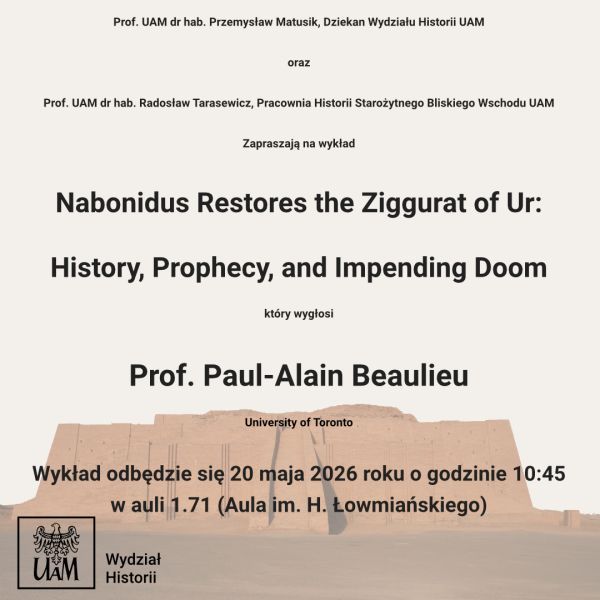


The Faculty of History at AMU is pleased to invite you to a lecture by Professor Paul-Alain Beaulieu from the Department of Near and Middle Eastern Civilisations at the University of Toronto. He is recognised as one of the leading contemporary scholars in the history and culture of ancient Mesopotamia.
Prof. Paul-Alain Beaulieu specialises in the history, religion and culture of Babylonia in the first millennium BCE. He studied history and law at the Université de Montréal and subsequently obtained a PhD in Assyriology from Yale University. Throughout his academic career, he has been affiliated with several institutions, including Harvard University and the University of Notre Dame. Since 2006, he has been working at the University of Toronto. He is the author of various fundamental publications on the history of Babylonia, Mesopotamian religion and cuneiform texts, including the books *A History of Babylon*, *The Pantheon of Uruk* and *The Reign of Nabonidus*. In 2020, he was elected a Member of the Royal Society of Canada.
The lecture discusses the final years of the reign of Nabonidus – the last king of Babylonia – and the restoration of the E-lugal-galga-sisa ziggurat in Ur, a temple dedicated to the moon god Sin. Prof. Beaulieu will outline the political and religious significance of this undertaking, demonstrating how Nabonidus sought to realise his vision of a Babylonian empire dedicated not only to Marduk and Nabû, but also to the lunar deities of Ur and Harran.
The lecture will also examine the mounting political and religious tensions that preceded the fall of Babylonia – the growing threat of a Persian invasion and the intensifying criticism of the ageing ruler. Particular attention is devoted to the rhetoric of Nabonidus’s building inscriptions and their links to Mesopotamian cuneiform historiography.
We warmly invite anyone interested in the history of the ancient Near East, the religion of Mesopotamia and cuneiform culture.