


A nationwide study, published in Nature Climate Change, shows that viable seed production in major European forest trees has declined by over 30% in three decades, even after accounting for declining seed demand. Forests depend on seeds to renew after logging, drought, pests, storms and fire. Yet new research, led by researchers at the Forest Biology Centre, Adam Mickiewicz University, Poznan, shows that several of Europe’s dominant forest-forming tree species are now producing far fewer viable seeds than they did three decades ago.
The study, “Forest tree fecundity declines as climate shifts,” analysed 40,530 annual seed-harvest observations collected across 438 forest districts in Poland between 1988 and 2021. The records covered five major taxa: European beech, silver fir, Scots pine, pedunculate oak and sessile oak.
The declines were large; Viable seed production fell by around 65% in oaks, 64% in Scots pine, 44% in silver fir and 32% in European beech. These changes were detected after accounting for seed collection effort . This is important because seed collection records reflect both biological seed availability and how much seed foresters need for planting.
“Harvest records should be treated with caution because people collect seeds when they need them,” said Dr Jessie J. Foest, lead author of the study and researcher at the AMU Forest Biology Centre. “That is exactly why the demand data were so important. Demand also declined through time, but the fecundity decline remained after we accounted for it. This means the pattern cannot be explained only by people collecting fewer seeds.”
The study shows that the strongest driver of the decline was summer warming, especially during the years when trees initiate the flowers that later become seeds. Across species, hotter summers were linked to lower viable seed output. Spring temperatures and growing-season moisture also affected reproduction in some places, yet they explained less of the long-term decline than summer warming.
“Trees are not only vulnerable to the negative effects of climate change when seedlings or adult trees die”, said Foest. “If reproduction is under chronic strain, the forest may still look intact, while its capacity to replace itself is already weakening.” The findings matter because the records reflect post-sorting seed lots, meaning seeds that had passed quality control and were largely excluded from empty, damaged or infested seeds. The decline, therefore, points to reduced effective reproductive output rather than a change in total litter, flowers or cones alone.
A second line of evidence came from the MASTREE+ database, an independent global dataset of plant reproductive records. For the same period and species, the researchers found declines in masting— the boom-and-bust pattern of seed production that many forest trees rely on as it improves pollination and overwhelms seed predators.
“Masting is not just a curiosity of tree reproduction,” said Prof. Michał Bogdziewicz, head of the Forest Biology Centre at AMU, senior author of the study. “Large seed years are when pollination works best, and seed predators are satiated. When warming disrupts that rhythm, viable seed production can decline even if trees still invest in reproduction.”
The results also show that climate effects differed among local populations. Some weather effects changed direction or strength depending on the long-term climate of a site. This suggests that local adaptation or acclimation may partly buffer reproduction in some populations, although the authors warn that such buffering may be too slow to keep pace with rapid warming.
“Poland’s forest seed records gave us a rare opportunity,” said Dr Jakub Szymkowiak, co-author of the study at Adam Mickiewicz University, Poznan. “They were collected for forest management, not for this specific ecological question. But because they cover many districts, many species and more than three decades, they allow us to see a reproductive signal that would be almost impossible to detect from short-term monitoring alone.”
The study has direct implications for forest regeneration and seed supply. If viable seed crops continue to decline, nurseries may face shortages of provenance-appropriate seed, and forests may have less capacity to recover after disturbance. This risk is greatest where seedling establishment is also constrained by drought and heat.
“Our results suggest that climate change is already reducing the reproductive capacity of major European trees,” Foest said. “The next question is whether these seed declines are now translating into weaker regeneration in forests. That is the link we urgently need to test.”
Foest J.J., Szymkowiak J., Dyderski M.K., Kelly D., Kunstler G., Jastrzębowski S., Bogdziewicz M. (2026) Forest fecundity declines as climate shifts. Nature Climate Change https://www.nature.com/articles/s41558-026-02638-5
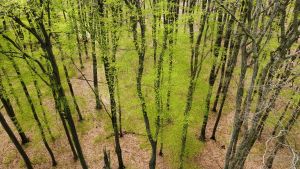
photo by dr Maciej Barczyk