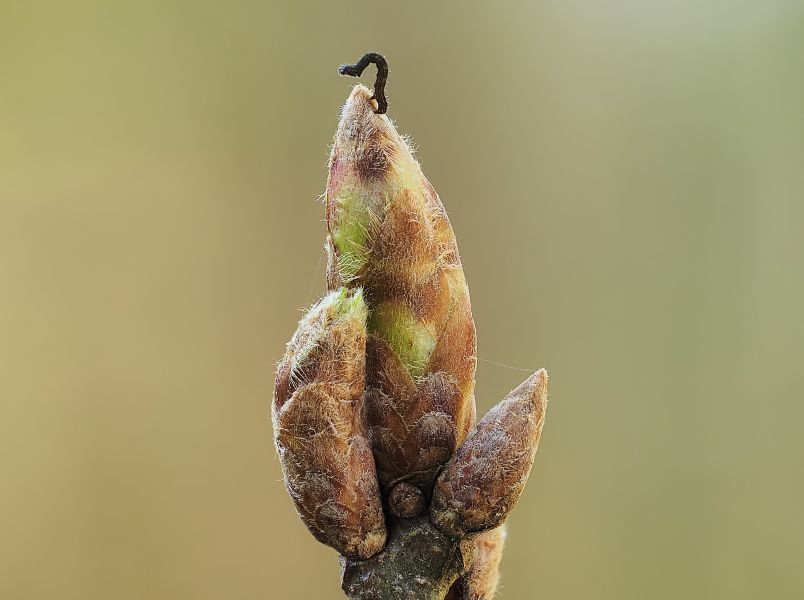



When oak trees are heavily damaged by caterpillars, they open buds later the following spring. An international research team has shown that this strategy is highly effective against their predators.
"During this time in spring, trees are getting leaves again. This is called budburst. Some trees get them earlier than others. Within tree species, some individual trees also get their leaves earlier than others. Many caterpillars, the larvae of moths and butterflies, like to eat those fresh, soft leaves. They thus must synchronise their activity with the timing of the budburst of the trees they are on. When the first author, Soumen Mallick, was visiting AMU for 6 months, we talked about how trees could avoid some of these caterpillars by varying the timing of their budburst. Now, with co-workers in Germany and France, he has addressed this question using big data from satellites. We showed that after a lot of caterpillar feeding during one year, trees often delay their leaving during the next, and that this indeed reduces caterpillar damage on these trees." ~ says Prof. Freerk Molleman.
To demonstrate these connections, the team used state-of-the-art interdisciplinary methods from ecology and remote sensing.
Previously, researchers had to laboriously observe individual trees on the ground. For this study, however, a 2,400-square-kilometre area in Northern Bavaria was monitored continuously using Sentinel-1 satellite data. What makes these radar satellites special is that they provide precise data on the condition of tree canopies even in thick cloud cover.
The researchers analysed a total of 137,500 individual observations spanning five years, from 2017 to 2021. The satellites provided data at a resolution of 10x10 metres per pixel, which roughly corresponds to the crown of a single tree. A total of 27,500 such pixels were analysed across 60 forest areas.
The year 2019 proved particularly revealing, as the region experienced a massive outbreak of the gypsy moth. “The radar sensors recorded exactly which trees were stripped bare and how they reacted in the following year, " emphasises Professor Jörg Müller, University of Würzburg (Germany) Chair of Conservation Biology and Forest Ecology and co-senior author of the study.
“This discovery fundamentally changes our previous understanding of the onset of spring in the forest,” says the Würzburg researcher. It shows that trees do not merely react passively to the weather in timing their leaves to emerge but also respond flexibly to biological threats.
The entire article is available at: https://www.nature.com/articles/s41559-026-03071-9
Photo: Stephan Thierfelder