


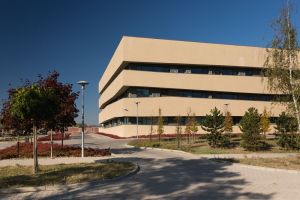
February and March 2026 went down in the AMU's history as a period of unprecedented success in intellectual property protection. The team from the Technological Processes Laboratory at the AMU Centre for Advanced Technologies secured three patents in just seven days, and a total of eight in quick succession!
This result is not the effect of individual ambition, but a prime example of teamwork, where the exchange of ideas and the joint pursuit of goals translates into tangible solutions for the economy. The mission of the Technological Processes Laboratory is to combine scientific research with its practical application. The projects undertaken are not limited to publications; instead, their aim is commercialisation and a real impact on modern industry.
Innovation in the service of the environment and durability
The team’s main area of success lies in the modification of polylactide (PLA), a biodegradable polymer that offers an environmentally friendly alternative to plastics derived from oil and natural gas. Thanks to the joint efforts of the researchers, they have succeeded in eliminating its greatest drawback, namely brittleness. The composites developed are characterised by significantly increased impact strength, which opens up a broad range of possible applications in the production of machine parts or structural components. The approach of Dr Robert Przekop’s team is based on combining the development of material composition with processing technology. The patent registration covers not only the recipes themselves, but also specific production methods (e.g. injection moulding or filament manufacturing). From the standpoint of potential industrial implementation, such documentation facilitates technology transfer, as it provides the ready-made process parameters necessary to commence production.
The Patent Process as Part of a Research Strategy
In scientific and implementation activities, patience and consistency are key. A patent is not granted immediately following a discovery. Administrative procedures, prior art searches and correspondence with Patent Office experts usually take between three and four years. Today’s successes are therefore the result of work initiated several years ago. It confirms that only consistent, well-organised research activity allows for the regular acquisition of legal protection for developed technologies. The team at the AMU Centre for Advanced Technology focuses on solutions that have a realistic chance of being applied in the economy, including in the plastics and 3D printing industries.
Success has many authors.
Why does teamwork win?
Modern science, especially technology-oriented science, is too complex for individual "solo efforts". The success of the team at the AMU Centre for Advanced Technologies (CZT) shows that a clear division of roles—ranging from chemical synthesis and strength testing to the optimisation of injection moulding and 3D printing processes—allows for a level of productivity that would be impossible to achieve when working individually.
Securing three patents within a single week demonstrates that a university laboratory can function with the dynamism of a modern tech start-up while upholding the highest standards of academic excellence. It sends a clear signal to the business community that researchers at Adam Mickiewicz University, Poznan, are a reliable and effective partner in R&D projects. Such success would not have been possible without efficient administrative coordination and a focus on intellectual property protection, which, within the University’s structures, enables the building of a strong AMU brand as a pro-innovation institution. Today’s decisions by the Patent Office confirm that the "science for the economy" strategy adopted years ago is yielding tangible results. At the AMU Centre for Advanced Technologies, some solutions are refined, proven and, most importantly, effectively protected by law.
Comment from the Adam Mickiewicz University Centre for Innovation and Technology Transfer
From the perspective of the Adam Mickiewicz University Centre for Innovation and Technology Transfer, the success of the AMU Laboratory of Technology Processes described here represents not only an individual achievement, but above all a confirmation of the strategic approach to building the University’s value based on intellectual property. From the perspective of technology transfer, it is particularly significant that these patents do not function as individual, isolated solutions but form a complementary body of knowledge and technology that strengthens the University’s position as a partner for industry. A coherent patent portfolio enhances the University's negotiating position in commercialisation processes, enables the development of long-term relationships with business, and fosters the creation of projects with a greater impact. It is worth emphasising that effective protection of intellectual property constitutes one of the University’s assets. Properly secured technological solutions not only protect the results of research work but also build measurable market value, forming the foundation for licensing and the creation of spin-off companies.