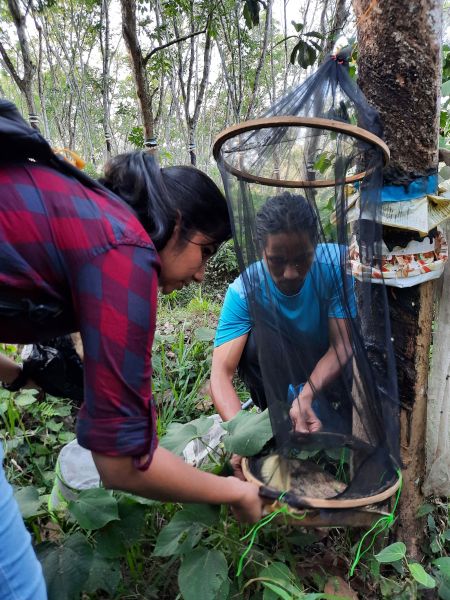


Contrasting mechanisms for using humidity as a cue for seasonal polyphenism in two tropical butterflies - a research conducted by scientists from the Department of Systematic Zoology at the Faculty of Biology, Adam Mickiewicz University, Poznan – Prof. Freerk Molleman, Prof. Urszula Walczak and their colleagues – has shown that two species of tropical butterflies respond to humidity, but through different mechanisms.
The researchers conducted experiments in which they varied the humidity levels during the rearing process. The studies revealed that the size of the eye spots on the wings of one species, Mycalesis mineus, was directly influenced by humidity. In contrast, for the other species, Melanitis leda, the size of the eye spots depended on the quality of the plants, which was itself affected by humidity. The researchers described their observations in a recently published article in the journal Proceedings B (https://doi.org/10.1098/rspb.2025.2986).
A parallel study published in Scientific Reports (https://doi.org/10.1038/s41598-026-40471-0) demonstrated that populations of Melanitis leda from various climatic zones respond differently to temperature and humidity. This finding aligns with the idea of local adaptation to environmental signals.
The research was funded by the National Science Centre under grant 2021/43/B/NZ8/00966.